
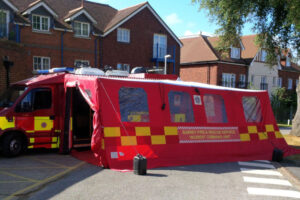
Shelter provides three working areas within large, easily assembled multi-purpose shelter.
When Surrey Fire and Rescue Service’s new ICU vehicle was deployed to provide communications support for the service’s wide-area, multi-agency flood rescue operations along its sector of the flooded river Thames in early 2014, the benefits of the service’s communications planning were apparent for all to see. Under very difficult conditions, the service was able to deliver very high levels of satellite broadband command communications, both for itself and for all local emergency services.
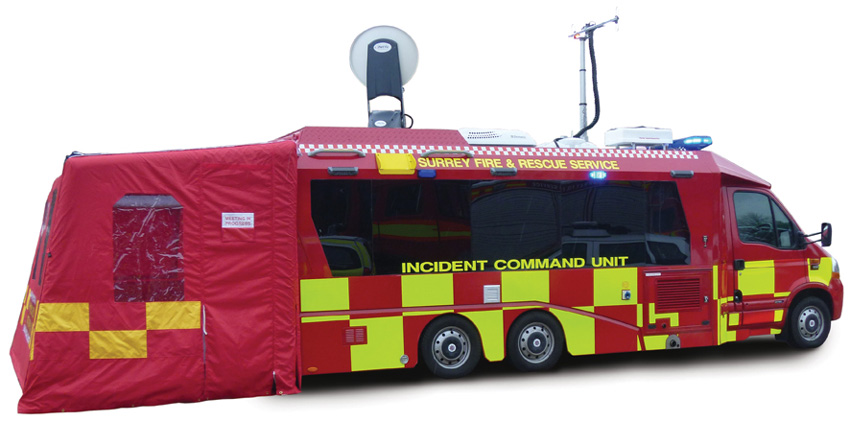
This was as a result of in-depth strategic incident command planning by Surrey FRS, combined with the support of mobile satellite broadband supplier Primetech and shelter supplier Aireshelta.
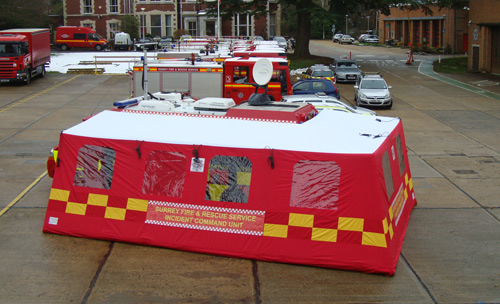
Another unique feature of the Surrey ICU is the space provided by it’s unique large L-shaped shelter, supplied by leading shelter manufacturer Aireshelta. With the space provided by the shelter the unit is able to handle, simultaneously, a diverse range of command functions, from IT and communications support to command meetings, administration and briefings. Shelters made in new, lightweight fabrics reduce the weight carried and are easier to deploy.
Surrey FRS’s new ICU was deployed to its Chertsey station (a few miles south west of Heathrow) which was the incident joint forward tactical operating base for around two weeks in mid-February, during the height of the flooding crisis. Based in the station’s car park, and connected into the main building, it was able to provide previously unobtainable levels of satellite broadband communications capacity in support of command and field teams from the fire service itself, along with police, ambulance and other agencies, the local authority and volunteers, as they battled to help local communities.
That it was able to do so was no accident. Surrey FRS’s new ICU probably represents the state-of-the-art in ICU thinking. When the service identified a requirement for a new, next-generation ICU it looked into the issue in great depth.
After the management team had set the strategy for incident command the project team looked at what functionality was required to deliver on the strategy. The ICU would be one of a number of vehicles and systems Surrey FRS planned to use for incident command, albeit the most sophisticated in terms of its technology and functionality.
Surrey FRS has a step approach to incident command. The larger the incident the more tools and functionality are rolled out to provide the command infrastructure. Incident commanders are trained to understand and use these tools to be able to perform their management of incidents. The ICU is used as part of this over arching command strategy
The service has rapid command units, which are converted Combo vans that carry a small Aireshelta, whiteboards and documentation, but are without satellite communications. At the next level is the Forward Command Unit, based on a Ford Transit van, which has satellite communications technology from Primetech, a laptop and tablet computers, and a high level of communications. It can be a hub for incident command and is used for more significant incidents but is also available for quick response.
Working with multi-agencies was a key part of the planning for the ICU. There was a definitive user requirement stating what was required in terms of inter-agency liaison: being able to have access to the media, for conferencing, briefing crews, holding silver command meetings, and collecting information. All this went into the service’s specification, as it is now doing more ‘blue light’ preparation than at any other time, working closely with the police, the ambulance service and the local authority on interoperability. The project team worked with other agencies in defining the specification, and they are continuing to work with other agencies now.
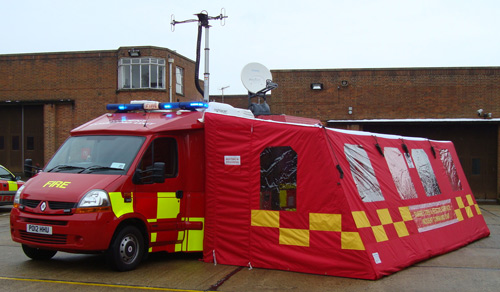 When the team was defining how it wanted the ICU and its associated shelter configured they decided that they needed three distinct areas: an area where skilled operators could work, working with IT, broadband, wifi, radios etc; they wanted an area where senior commanders could meet and make plans, again with IT support; and they wanted another area where they could hold meetings and conduct briefings for crews. That is why it specified the very large, L-shaped Aireshelta. The shelter is quite unique, because it creates a number of work spaces around the vehicle, tripling it in size.
Surrey FRS worked very closely with Aireshelta. Aireshelta designed the L-shaped shelter specifically for Surrey FRS. In addition to being very big, it is free standing as well providing added flexibility. So, if the service has an incident such as flooding, it could if required set the shelter and vehicle up, and whilst still conducting incident command in the shelter the vehicle can be driven away. This aspect had a lot of thought put into it. The shelter can also have external monitors mounted, so that crews can be briefed, on incident layouts for example.
Concerning staffing and training, the ICU has specialist operators on board but Surrey also currently has trained firefighters who understand and can use the functionality of the vehicle, and Surrey has held a series of exercises to consolidate this.
Kevin Bradley of Aireshelta, said: ‘The shelter we have designed and developed for Surrey FRS shows how emergency services of all kinds can expand substantially the amount of space they can provide for emergency teams, at a very reasonable cost. As a company that specialises in the manufacture of inflatable shelters, which are quick and easy to deploy, robust and very flexible in terms of designs and sizes, we are delighted that Surrey FRS has shown how such a shelter can be used to obtain maximum benefit from their investment in their advanced ICU.’